

Have you ever wondered what your birth chart actually reveals, or how astrology goes deeper than the horoscopes you find in magazines? This guide explores the fundamentals of astrology — from the zodiac and birth charts to planetary transits and what it all means for your everyday life.
What Is Astrology?
At its core, astrology is the ancient practice of interpreting the positions and movements of celestial bodies — the sun, moon, and planets — in relation to human experience. It’s grounded in the idea that the cosmos and our lives are deeply interconnected: that the patterns in the sky at the moment of our birth reflect something meaningful about our nature, our tendencies, and the themes that will recur throughout our lives.
Astrology has roots in virtually every major ancient civilization — Babylonian, Egyptian, Greek, Indian, and Chinese — and has evolved continuously over thousands of years. While it isn’t considered a science in the modern academic sense, it remains one of the most enduring symbolic systems for understanding human experience, and its insights continue to resonate meaningfully for millions of people worldwide.
The Birth Chart: Your Celestial Blueprint
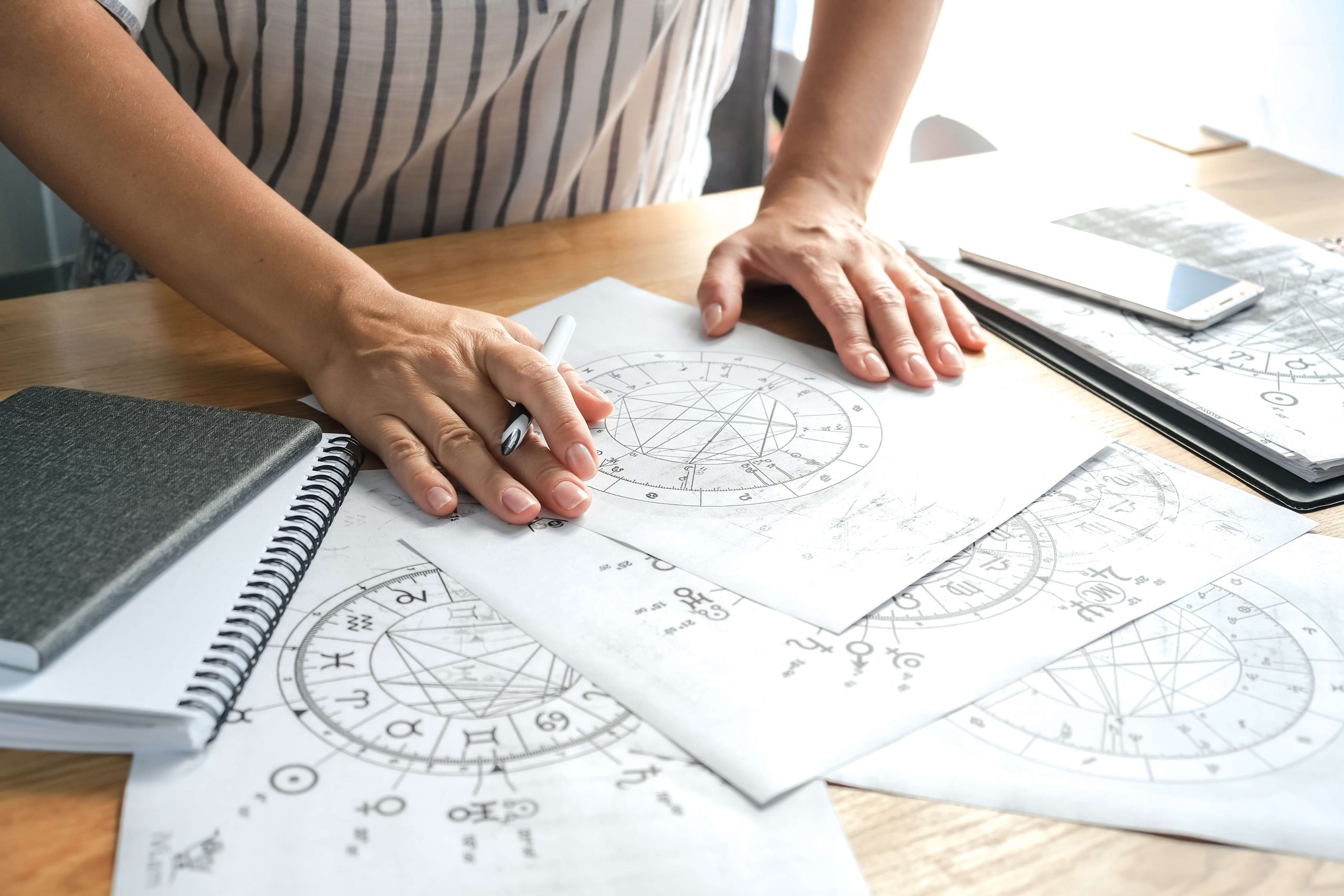
Your birth chart — also called a natal chart — is a map of where every planet in our solar system was positioned at the exact moment and location of your birth. It’s a circular diagram divided into twelve segments called houses, each associated with a different area of life (relationships, career, home, health, and so on). The planets are placed within these houses according to where they actually were when you were born.
No two birth charts are exactly alike — even twins born minutes apart can have meaningfully different charts, particularly in the fast-moving positions of the Moon and Ascendant (Rising Sign).
To generate your own chart, you’ll need your birth date, birth time (as precise as possible), and birth location. Free chart calculators are available at sites like Astro.com. The birth time is especially important: the Ascendant and the house placements shift significantly throughout the day, and an incorrect time can substantially change the chart’s interpretation.
The Zodiac Signs: Twelve Archetypal Energies
The twelve zodiac signs form the backdrop of the birth chart and astrology as a whole. Each sign occupies 30 degrees of the 360-degree zodiac and carries a distinct set of qualities, themes, and tendencies. The signs are grouped by element (fire, earth, air, water) and modality (cardinal, fixed, mutable), which shape how their energy is expressed.
Your sun sign — the one most people know from horoscopes — reflects the core of your conscious identity and the essence you’re meant to develop in this lifetime. But your sun sign is just one placement in a chart that contains ten planetary positions, twelve houses, and numerous aspects between them. A person with a Libra sun but a Scorpio moon and Aries rising will experience life quite differently from another Libra with different surrounding placements.
Horoscopes: Celestial Guidance for the Masses
Horoscopes — the brief astrological forecasts you find in newspapers and magazines — are based on the sun sign alone, which is why they’re necessarily general. They can be a fun and occasionally insightful entry point into astrology, but they’re a simplified version of a much richer system.
A personalized reading based on your full birth chart offers considerably more depth, because it accounts for where every planet was positioned at your birth and how those positions interact with each other and with current planetary movements.
Planetary Transits and Aspects
Planets don’t stay still after you’re born — they continue moving, and as they do, they form relationships with the positions in your natal chart. This is what astrologers call transits, and they’re one of the primary tools for understanding why certain periods feel energetically distinct from others.
Aspects are the angular relationships between planets, both in your birth chart and in transits. Conjunctions (planets at the same degree), squares (90 degrees apart), trines (120 degrees), and oppositions (180 degrees) each describe a different quality of relationship — supportive, challenging, harmonious, or polarized. Understanding which transits are active in your chart at any given time can help explain why certain themes are intensifying in your life right now.
Astrology in Daily Life
One of the practical gifts of astrology is its capacity to provide a larger context for the rhythms of life. Periods that feel heavy or stuck often coincide with challenging transits. Times that feel unusually clear or energized often align with favorable planetary movements. Understanding these cycles doesn’t give you control over them — but it can reduce the disorientation of feeling like circumstances are happening to you, and help you align your actions with the prevailing energy rather than working against it.
Astrology and Self-Discovery
For many people, the most valuable use of astrology is not prediction but self-understanding. A birth chart is a remarkably detailed map of temperament, motivation, unconscious patterns, and areas of potential growth. Exploring your chart — particularly the Moon sign (emotional nature), the Ascendant (how you meet the world), and the position of Saturn (where you face your deepest lessons) — can illuminate patterns in your life that might otherwise feel inexplicable.
Astrology and tarot work particularly well together in this context. Where the birth chart offers a relatively stable picture of your core nature and long-term cycles, tarot cards reflect the living moment — what’s most active or in need of attention right now. The two practices complement each other naturally.
Approaching Astrology with Openness
Skepticism is a healthy starting point with any symbolic system, and astrology is no exception. The practice doesn’t require you to believe that the planets literally cause events on Earth — many practitioners understand it as a form of symbolic correspondence rather than direct causation. What matters most is whether the framework feels useful for reflection and self-understanding.
If you’re curious but uncertain, the simplest approach is to generate your birth chart, read about your major placements, and see what resonates. The proof of any reflective system is in how much it illuminates — and many people are surprised by how specifically their chart seems to speak to patterns in their actual lives.
Frequently Asked Questions
-
Can astrology predict my future? Astrology offers insight into energetic tendencies, cycles, and the themes likely to be prominent during a given period — not fixed outcomes. How those themes manifest in your specific life depends on your choices, circumstances, and countless other factors. Think of it as a weather forecast rather than a predetermined script.
-
Is astrology a science or a belief system? It’s neither straightforwardly one nor the other. Astrology is a symbolic system with ancient roots that has been practiced continuously across cultures. It operates through pattern, analogy, and interpretation rather than empirical hypothesis-testing. Many practitioners relate to it as a contemplative or reflective practice rather than a predictive science.
-
How do I explore my birth chart? Start by generating your chart at a reputable site like Astro.com using your birth date, time, and place. Then explore the big three: your Sun sign (core identity), Moon sign (emotional nature), and Rising sign (the face you present to the world). These three placements together paint a much richer portrait than the Sun sign alone.
-
Do astrological influences change over time? Yes. Your natal chart remains constant — it’s a snapshot of the sky at your birth. But the planets continue moving, and the transits they make to your chart create cycles of activation and ease that shift throughout your life.
-
Can astrology help me understand my relationships better? Yes. The branch of astrology called synastry examines how two people’s birth charts interact, revealing areas of natural flow and areas of friction. It’s a valuable tool for understanding relationship dynamics with more nuance than personality types alone can offer.
This article was last updated in April 2026.
Recent Posts

Tarot and Astrology: How These Two Ancient Practices Work Together
Tarot and astrology have been intertwined for centuries, each enriching the other with complementary symbolism. Discover how these two ancient practices connect — from shared archetypes to timing — and why working with both is more powerful than either alone.

What Is Astrology? Birth Charts, Zodiac Signs & How It All Works
Astrology is one of humanity’s oldest symbolic systems — but what does it actually involve beyond daily horoscopes? This guide explores birth charts, zodiac signs, planetary transits, and how astrology works as a tool for self-understanding.

Major Arcana Tarot Cards: Meanings, Symbolism & the Fool’s Journey
The Major Arcana are the 22 most powerful cards in the tarot deck. This guide explores their meanings, their symbolism, the Fool’s Journey framework, and how to interpret them in your readings.