

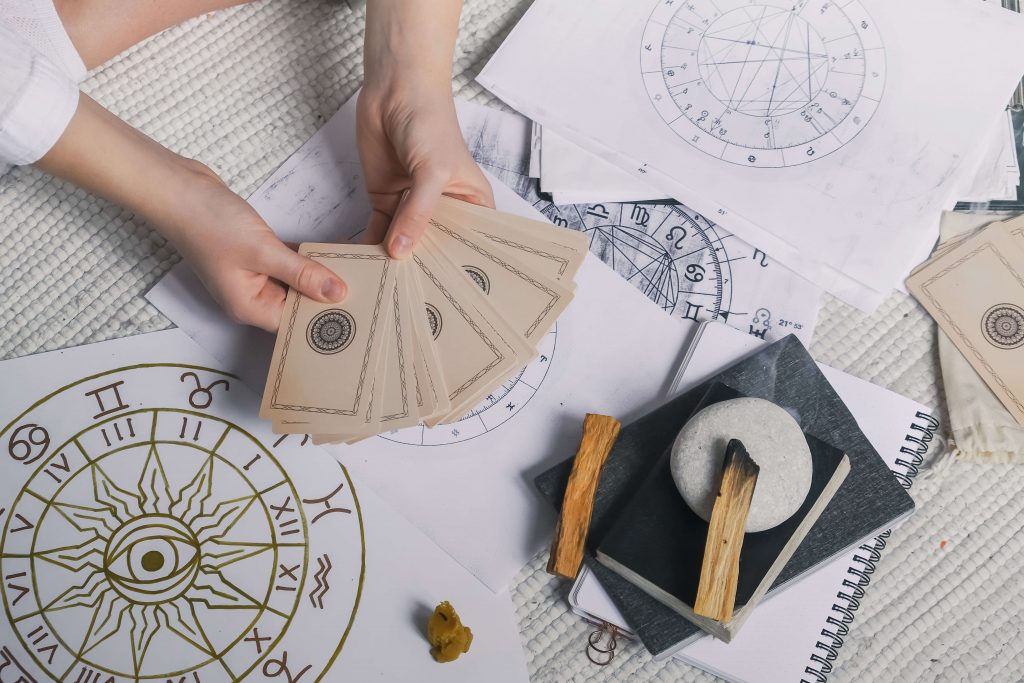
Tarot and astrology have been intertwined for centuries, each enriching the other with complementary symbolism and insight. This guide explores how these two practices connect — and how working with both can deepen your understanding of yourself and the moment you’re in.
Two Ancient Practices, One Symbolic Language
Tarot and astrology developed along parallel tracks for centuries before their connections were formalized. By the 18th and 19th centuries, occultists in Europe — particularly within the Hermetic and Rosicrucian traditions — had woven the two systems together extensively, assigning specific astrological correspondences to tarot cards and incorporating planetary symbolism into the deck’s visual language.
Today, virtually every standard tarot deck carries embedded astrological references, whether explicitly noted in the guidebook or encoded in the imagery. Understanding these connections makes both practices richer — and using them together can offer a depth of insight that neither provides quite as well alone.
Tarot: A Window into the Present Moment
The tarot deck’s 78 cards — divided into the Major Arcana (22 cards) and the Minor Arcana (56 cards) — form a symbolic map of human experience. Readings draw on this map to illuminate what’s most active or in need of attention right now: what energies are present, what patterns are playing out, and what possibilities or choices are in view.
Tarot is fundamentally responsive to the present moment. It reflects the living situation with remarkable specificity, making it particularly well suited for real-time guidance and reflection.
Astrology: Mapping Cycles and Character
Astrology operates differently. Where tarot reads the moment, astrology reads the pattern — the longer cycles and deeper character structures revealed by the positions of the planets at birth and their ongoing movements through the sky. A birth chart offers a stable portrait of temperament, recurring themes, and areas of potential challenge and growth. Transits and progressions show how those themes are being activated or transformed over time.
Both systems ultimately serve the same purpose — deeper self-understanding and more conscious navigation of life — but they approach it from different angles and different timescales.
Shared Symbolism: Where the Two Systems Converge
The correspondences between tarot and astrology are extensive and specific. Here are some of the most significant connections:
Each of the 22 Major Arcana cards has a traditional astrological assignment. The Empress is associated with Venus — themes of beauty, abundance, fertility, and sensual pleasure. The Emperor corresponds to Aries, carrying that sign’s energy of leadership, structure, and the assertion of will. The High Priestess aligns with the Moon — intuition, the subconscious, cyclical wisdom. The Tower connects to Mars, the planet of sudden disruption and purging force. The World is associated with Saturn — completion through discipline and the mastery of lessons learned.
The four suits of the Minor Arcana map directly onto the four elements: Wands to fire (Aries, Leo, Sagittarius), Cups to water (Cancer, Scorpio, Pisces), Swords to air (Gemini, Libra, Aquarius), and Pentacles to earth (Taurus, Virgo, Capricorn). Each of the 36 numbered Minor Arcana cards (Ace through Ten) is also assigned to a specific astrological decan — a ten-degree segment of a zodiac sign — giving every card an astrological address within the calendar year.
How the Two Practices Strengthen Each Other
Enhancing Intuition and Insight
Both practices develop intuition, but in complementary ways. Tarot cultivates the ability to read a situation in the moment — to see what’s present, what’s hidden, and what’s possible — through symbolic imagery and pattern recognition. Astrology builds the capacity to see within larger cycles: to recognize where a current experience fits in the longer arc of someone’s development, and what archetypal forces are at work beneath the surface events.
A practitioner fluent in both has access to a considerably wider symbolic vocabulary and a richer set of frames through which to understand any given situation.
Timing and Synchronicity
One of the most practical benefits of combining tarot and astrology is the way they address timing together. Tarot readings are excellent at identifying the “what” — the theme, the dynamic, the energy that’s present. Astrology adds the “when” — the awareness that a Mercury retrograde might be intensifying communication challenges right now, or that a Saturn transit is bringing a period of consolidation and restructuring that will last another year.
When a tarot reading reflects something difficult, knowing the astrological context can provide both explanation and perspective: this challenge is part of a meaningful cycle that will eventually shift. When a reading is unusually clear or propitious, astrology might confirm that the planetary weather genuinely supports forward movement right now.
Personal Growth and Reflection
Both practices are ultimately tools for self-awareness. Tarot invites reflection on current experience with remarkable specificity. Astrology provides a map of ingrained patterns, potential, and the timing of developmental shifts. Used together over time, they create a genuinely rich framework for understanding yourself — where you’ve been, where you are, and what you’re moving toward.
Many practitioners find that exploring their birth chart deepens their relationship to the tarot cards associated with their major astrological placements. Someone with a strong Scorpio signature in their chart, for example, often finds that the Death card — traditionally associated with Scorpio — speaks to them with particular resonance and personal relevance.
Frequently Asked Questions
Can tarot cards be associated with specific zodiac signs?
Yes, and the associations are both traditional and precise. The Strength card corresponds to Leo, reflecting that sign’s themes of courage, heart, and the mastery of instinct through love rather than force. The Hermit aligns with Virgo — introspection, discernment, the wisdom found in solitude. The Justice card connects to Libra, the sign of balance, fairness, and the weighing of choices. These correspondences add another layer of meaning to any reading for someone familiar with their own chart.
How do planetary transits influence tarot readings?
Planetary transits can illuminate why certain cards or themes are appearing repeatedly in readings during a particular period. During a Mars transit, for instance, themes of conflict, assertion, or decisive action may arise more frequently. A Venus transit tends to bring relationship and abundance themes to the fore. Being aware of the current planetary weather can help you interpret the cards you’re drawing with greater contextual accuracy.
Can tarot and astrology predict the future?
Neither system offers fixed predictions. Both work with energies, tendencies, and probabilities rather than certainties. Astrology identifies cycles and the themes likely to be prominent during a given period; tarot shows what’s most alive in the current moment. Both are most useful when approached as tools for awareness and reflection rather than as oracles delivering pre-determined outcomes.
Are there tarot spreads designed for astrological work?
Yes. The twelve-card zodiac spread, for example, assigns one card to each house of the birth chart, offering a reading that addresses every major life area at once. Some readers also use a spread timed to astrological events — a new moon, a solstice, or a significant transit — as a way of connecting their tarot practice to the larger rhythms of the year.
Can someone become skilled in both tarot and astrology?
Absolutely — and many practitioners find that learning both deepens their mastery of each. The shared symbolic vocabulary accelerates learning in both directions. Understanding planetary archetypes enriches tarot interpretation; working with tarot makes the planetary archetypes more vivid and experientially real. Both practices reward patience and consistent engagement over time.
Conclusion
Tarot and astrology are two of the oldest and most enduring symbolic systems we have for understanding human experience — and their convergence creates something greater than either alone. Whether you begin with one and find your way to the other, or explore them together from the start, the two practices offer a lifetime of insight, reflection, and self-discovery. The invitation is simply to engage with them honestly, openly, and with genuine curiosity about what they have to show you.
This article was last updated in April 2026.
Recent Posts
Tarot and Astrology: How These Two Ancient Practices Work Together
Tarot and astrology have been intertwined for centuries, each enriching the other with complementary symbolism. Discover how these two ancient practices connect — from shared archetypes to timing — and why working with both is more powerful than either alone.
What Is Astrology? Birth Charts, Zodiac Signs & How It All Works
Astrology is one of humanity’s oldest symbolic systems — but what does it actually involve beyond daily horoscopes? This guide explores birth charts, zodiac signs, planetary transits, and how astrology works as a tool for self-understanding.
Major Arcana Tarot Cards: Meanings, Symbolism & the Fool’s Journey
The Major Arcana are the 22 most powerful cards in the tarot deck. This guide explores their meanings, their symbolism, the Fool’s Journey framework, and how to interpret them in your readings.