

If you’re new to tarot, the vocabulary can feel like a small obstacle standing between you and actually understanding what’s happening in a reading. A few key terms go a long way. Here’s a plain-language glossary of the most important tarot concepts, so you can approach your next reading with confidence rather than confusion.

Inverted (Reversed) Cards
An inverted or reversed tarot card is simply a card that appears upside down when drawn. In tarot tradition, a card’s reversal typically modifies its meaning — though not always by simply flipping it to the opposite. Reversed cards more commonly suggest that the card’s energy is blocked, internalized, delayed, or being expressed in a more complicated or unconscious way.
For example, the upright Strength card suggests courage, patience, and inner mastery. Reversed, it might indicate self-doubt, suppressed power, or strength that hasn’t yet been claimed. Some readers work extensively with reversals; others prefer to read all cards upright. There’s no universal right approach — it’s a matter of reading style. While the free online tarot card readings on this site don’t include physically reversed cards in the layout, the reversed meaning is included for each card — see the Ten of Pentacles as an example (scroll below the video for the reversed meaning).
Querent
The querent is the person receiving the tarot reading — the one whose question or situation the reading is addressing. If you’re doing a self-reading, you are the querent. If you’re having a reading done by someone else, you’re still the querent; the reader is simply the interpreter. The term comes from the Latin quaerens, meaning “one who seeks.” You’ll encounter it frequently in books and articles about tarot, where it’s used to refer to the person whose life or question the reading centers on.
Court Cards
Court cards are the “people” cards in each suit of the Minor Arcana. Every suit contains four court cards: the Page, Knight, Queen, and King. Some decks use different names — Princess, Prince, Queen, and King, for instance, or Daughter, Son, Mother, and Father — but the underlying structure is the same.
In a reading, court cards can represent actual people in the querent’s life, or they can describe qualities, energies, or personality traits that are relevant to the situation. A Queen of Cups appearing in a reading might point to a nurturing, emotionally attuned person in the querent’s circle, or it might reflect a quality the querent themselves needs to embody right now. Jungian psychology — with its concept of 16 archetypal personality types — maps closely onto the court card system and can enrich your understanding of these cards considerably.
Major and Minor Arcana
Every standard tarot deck of 78 cards is divided into two sections. The Major Arcana consists of 22 cards (numbered 0 through 21) that represent significant life themes, archetypal forces, and major turning points: The Fool, The Magician, The High Priestess, The Tower, The World, and so on. When a Major Arcana card appears in a reading, it typically signals something of deeper or broader significance than everyday circumstances.
The Minor Arcana consists of the remaining 56 cards, organized into four suits of 14 cards each (Ace through Ten, plus four court cards). These cards tend to reflect the texture of daily life — emotions, decisions, relationships, practical matters. A reading dominated by Minor Arcana cards usually points to situations that are more within the querent’s immediate influence and control.
Cartomancy
Cartomancy is the broader practice of fortune-telling or divination using any kind of playing cards — not just tarot. The term comes from the French carte (card) and the Greek manteia (divination). Cartomancy using standard 52-card playing decks was popular in Europe from at least the 14th century onward, predating the widespread use of tarot for divination purposes. Today, tarot has become the primary form of cartomancy, though readings with regular playing cards remain practiced in several traditions.
The Four Elements
Each of the four suits in the Minor Arcana corresponds to one of the classical elements, which shapes the suit’s overall energy and themes:
- Wands — Fire: passion, creativity, ambition, drive, and spiritual energy.
- Cups — Water: emotion, intuition, relationships, dreams, and the inner life.
- Swords — Air: thought, communication, conflict, clarity, and decision-making.
- Pentacles — Earth: the material world, finances, the body, work, and practical matters.
Understanding which element dominates a reading — or noticing a significant absence of a particular suit — can add a useful layer of context to your interpretation.
The Celtic Cross Layout
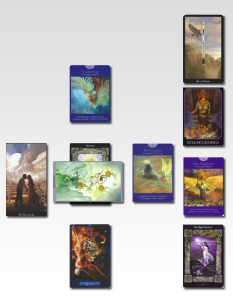 The Celtic Cross is one of the oldest and most widely used tarot spreads. It uses ten cards arranged in a specific pattern: six cards forming a cross shape in the center, with an additional four cards arranged in a vertical column to the right. Each position in the spread carries a defined meaning — the current situation, what crosses or challenges it, past influences, potential future, the querent’s attitude, external influences, hopes and fears, and the likely outcome.
The Celtic Cross is valued for the comprehensive picture it provides. Because it examines a situation from so many angles simultaneously, it’s particularly well suited to complex questions where multiple factors are at play. You can try a Celtic Cross tarot reading directly on this site.
Significator
A significator is a card that a reader deliberately selects — before the reading begins — to represent the querent themselves. The chosen card is typically set aside and placed in a specific position in the spread, where it anchors the reading to the querent’s identity and energy.
Significators are usually chosen from the court cards (a card whose personality archetype fits the querent) or from the Major Arcana (based on the querent’s astrological sign or life theme). Not all readers use significators — it’s a traditional technique that some find helpful for focus and others prefer to skip in favor of allowing all 78 cards to remain available for the reading itself.
The Fool
The Fool is card number 0 in the Major Arcana — and its unusual zero designation is intentional. The Fool stands outside the numbered sequence, representing the soul at the very beginning of its journey: open, unformed, full of potential, and not yet shaped by the lessons of the cards that follow. The Fool can appear at any point in the Major Arcana’s narrative, embodying the always-available possibility of a fresh start.
Some readers remove The Fool from the deck before a reading; others keep it in. The decision is personal and doesn’t significantly affect a reading either way.
Diviner (Reader)
In tarot vocabulary, a “Diviner” is the person who reads and interprets the cards — what most people simply call a tarot reader. The term comes from divination, the broader practice of seeking insight through symbolic or intuitive means. A skilled Diviner brings together knowledge of tarot symbolism, intuitive awareness, and sensitivity to the querent’s situation to create a meaningful and useful reading.
If you’re considering working with a professional reader, our guide to choosing a tarot reader covers what to look for and the questions worth asking before you book a session.
Every card in the free readings on this site includes a written description and a short video that explains the card’s meaning in relation to your question. As you become more familiar with the vocabulary above, those descriptions will start to make considerably more sense — and your readings will become more meaningful as a result.
This article was last updated in April 2026.